Unlocking Creative Potential with Game Controller SVG Assets
In the rapidly evolving landscape of digital design and physical manufacturing, the ability to adapt a single graphic asset across multiple platforms is essential. Whether you are a professional graphic designer crafting a brand identity or a hobbyist looking to personalize a custom project, the format in which your artwork exists often dictates its utility. The Game Controller SVG has emerged as a versatile icon that transcends simple imagery, serving as a foundational element for everything from video game branding to educational materials. This comprehensive guide explores the multifaceted nature of these assets, specifically focusing on the value provided by a complete package containing six distinct file formats.
The modern creator does not just need an image; they need a workflow solution. A standard raster image might suffice for a quick social media post, but it fails when scaled for a large banner or cut by a laser machine. By providing a diverse suite of files—including SVG, PNG, DXF, AI, PDF, and JPEG—the design ecosystem becomes fluid. Each format serves a specific purpose, ensuring that the core concept of the game controller remains crisp and editable regardless of the medium.
The Technical Superiority of Vector Formats
At the heart of this collection lies the SVG (Scalable Vector Graphics) file. Unlike pixel-based images that lose quality when enlarged, vector graphics are defined by mathematical equations. This means a Game Controller SVG can be resized from the size of a business card to the dimensions of a billboard without any loss of sharpness or detail. For professionals utilizing software like Adobe Illustrator or Inkscape, the SVG format offers the highest level of editability. You can alter colors, adjust stroke widths, and modify individual paths to fit a specific color palette or brand guideline instantly.
Complementing the SVG is the AI (Adobe Illustrator) file. While similar in function, the AI format is the native workspace for the industry-standard vector editor. It preserves layers, grouping, and advanced editing capabilities that are crucial for complex design projects. When working on intricate logo designs or preparing artwork for print production, having the source AI file ensures that every element of the game controller motif remains accessible for fine-tuning. This level of control is what separates amateur output from professional-grade deliverables.
The inclusion of the PDF (Portable Document Format) adds another layer of versatility. PDFs are universally compatible and excellent for sharing designs that need to maintain their layout integrity across different devices. For educators or researchers who wish to include high-quality diagrams of gaming hardware in reports or presentations, the PDF version of the Game Controller SVG ensures that the visual data is presented clearly without requiring the recipient to have specialized vector software installed.
Bridging Digital Design and Physical Manufacturing
One of the most significant advantages of this multi-format package is its direct application in physical fabrication. The DXF (Drawing Exchange Format) file is the bridge between digital creativity and physical reality. DXF files are the standard language for computer-aided design (CAD) and are required by virtually all CNC machines, laser cutters, and vinyl plotters. If you own a Cricut, Silhouette, or a commercial laser cutter, the Game Controller SVG in DXF format allows you to cut vinyl decals, engrave wood, or cut acrylic signs with precision.
This capability opens up a vast array of opportunities for small business owners and makers. Imagine creating a line of merchandise featuring retro gaming aesthetics. With the DXF file, you can cut out controller shapes from felt for plush toys, carve them into wooden coasters, or create stencils for painting t-shirts. The transition from a digital file to a tangible product is seamless, eliminating the need for third-party conversion tools that often introduce errors or degrade the quality of the lines.
The 300 DPI resolution mentioned for the raster components further supports physical production. High-resolution PNG and JPEG files are critical when sending artwork to commercial printing houses for items like stickers, magnets, or party supplies. These formats ensure that the edges of the game controller remain sharp and the colors are vibrant, even after the printing process. For those designing invitations or stationery, the ability to resize and recolor the controller graphic without pixelation guarantees a polished final result.
Diverse Applications Across Industries
The utility of these assets extends far beyond the realm of traditional graphic design. The Game Controller SVG and its accompanying formats serve as a universal symbol for interaction, technology, and entertainment, making them relevant to a broad spectrum of industries.
- Branding and Marketing: Business owners in the gaming sector can use the AI and SVG files to create cohesive logos and brand identities. The ability to easily change colors allows a company to adapt its visual identity for different campaigns while maintaining recognition.
- Educational Resources: Educators and researchers can incorporate these images into lesson plans about technology history, human-computer interaction, or digital literacy. The PDF and high-res PNG versions are perfect for handouts and slide decks.
- Craft and DIY Projects: Hobbyists utilize the DXF and SVG files for cutting mats, creating wall art, or personalizing home decor. The flexibility to rotate and crop the design allows for unique compositions that stand out.
- Fashion and Accessories: Clothing designers and jewelry makers can use the vector outlines to create screen-printed designs or laser-cut metal pendants. The clean lines of the vector format ensure that even the smallest details of the controller are reproduced accurately.
- Digital Products: Web developers and UI/UX designers can implement the SVG directly into websites. Because SVG code is lightweight, it improves page load speeds compared to heavy image files, enhancing the user experience.
The Workflow Efficiency of a Complete Package
Consider the typical workflow of a creative professional. They receive a request to design a sticker pack, a website icon, and a promotional poster for a gaming event. Without a comprehensive package, the designer would need to purchase separate files for each format, potentially paying extra fees and dealing with inconsistent licensing. Alternatively, they might attempt to convert a low-quality image, wasting hours trying to trace vectors or upscale pixels.
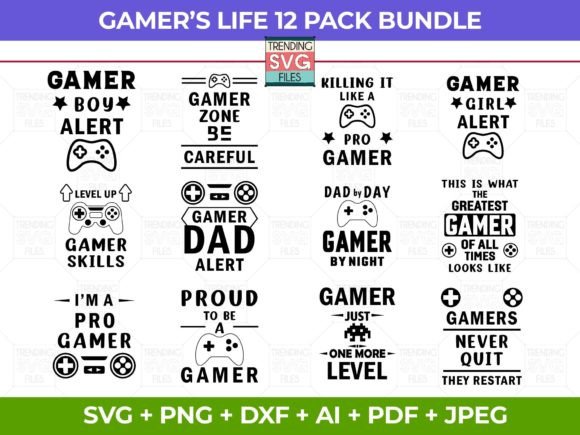
A package that includes 12 files in each of the six formats (SVG, PNG, DXF, AI, PDF, JPEG) streamlines this entire process. The 12 variations within the ZIP folder suggest a range of styles or perspectives, offering further customization options. Whether the user needs a side profile, a top-down view, or a stylized artistic interpretation, having multiple options within the same set allows for rapid prototyping.
The organization of these files into individual ZIP folders for each format simplifies the download and management process. Instead of sifting through a chaotic mix of hundreds of files, creators can quickly access the specific type they need for their current task. This structural efficiency translates directly into time savings, allowing more focus on the actual creative work rather than file management.
Adaptability and Customization
The true power of vector-based assets lies in their malleability. The prompt highlights that users can resize, recolor, crop, and rotate the designs. This statement underscores the non-destructive nature of working with SVG and AI files. Recoloring a Game Controller SVG is as simple as selecting a new hex code or swatch, changing the entire mood of the design instantly. Need a neon green controller for a cyberpunk theme? Or perhaps a monochrome black version for a minimalist aesthetic? Both are achievable in seconds.
Cropping and rotating offer further creative freedom. A designer might take a detailed illustration of a controller and crop it to feature just the joystick, using that isolated element as a subtle background texture or a repeating pattern for wallpaper. Rotating the image can help integrate it into dynamic layouts where diagonal lines add energy and movement to the composition.
For those adding other elements, the layered nature of the AI and SVG files is invaluable. You can place text over the controller, combine it with other icons to form a collage, or mask it behind shapes to create depth. This interoperability ensures that the game controller is not just a static image but a building block for larger, more complex compositions.
Ensuring Quality and Consistency
Quality assurance is paramount when purchasing digital assets. The specification of high-resolution formats addresses the common issue of blurry or pixelated output. In the world of print, where the difference between 72 DPI and 300 DPI is the difference between a professional brochure and a rejected proof, the inclusion of 300 DPI PNG and JPEG files provides peace of mind. Users do not need to worry about the limitations of screen resolution affecting their final product.
Furthermore, the consistency across formats ensures that the design intent is preserved. The geometric relationships established in the vector file are maintained in the raster exports. This means that whether the design ends up on a tiny mobile app icon or a massive outdoor banner, the proportions and clarity remain intact. This reliability is a hallmark of well-curated digital products and is essential for maintaining brand integrity.
Conclusion on Versatility
The integration of a Game Controller SVG into a diverse library of file formats represents a strategic approach to digital asset creation. It acknowledges the varied needs of different users, from the technical requirements of a laser cutter operator to the aesthetic demands of a web developer. By providing a complete ecosystem of 12 files per format, the package empowers creators to execute their visions without technical constraints.
Whether inspiring a new line of party supplies, facilitating research into gaming culture, or serving as a core component of a startup's brand identity, these assets demonstrate the enduring relevance of the game controller as a cultural icon. The flexibility to manipulate, scale, and apply these designs ensures that they remain useful tools for years to come, adapting to new trends and technologies as they emerge. In a market saturated with static images, the dynamic potential of this multi-format collection stands out as a superior choice for anyone serious about their craft.